
Close
You have no items in your shopping cart.

Electromagnetic compatibility (EMC) is the branch of electrical engineering that focuses on protecting electronic devices from the interference of electromagnetic energy. The unintentional generation or reception of electromagnetic energy may cause electromagnetic interference (EMI) and damage the equipment. Along with the steep and continuous increase in electronic device usage comes a corresponding increase in the possibility of interference, making EMC testing more crucial than ever.

The four types of EMC testing include: conducted immunity, conducted emissions, radiated immunity, and radiated emissions. Specific standards have been developed to ensure safety and repeatable results when testing equipment that must be followed. IEC (International Electrotechnical Commission), ISO (International Organization for Standardization), and CISPR                   (International Special Committee on Radio Interference) work individually and together to create these standards in order to provide solutions to current global change. Our EMC and EMI testing equipment has been designed to fulfill these specific test standards such as MIL-STD-461EN/IEC-61000-4, and CISPR.

Developers of automotive, medical, defense, aerospace, and consumer electronics technology all rely on EMC testing to ensure devices meet strict industry requirements.

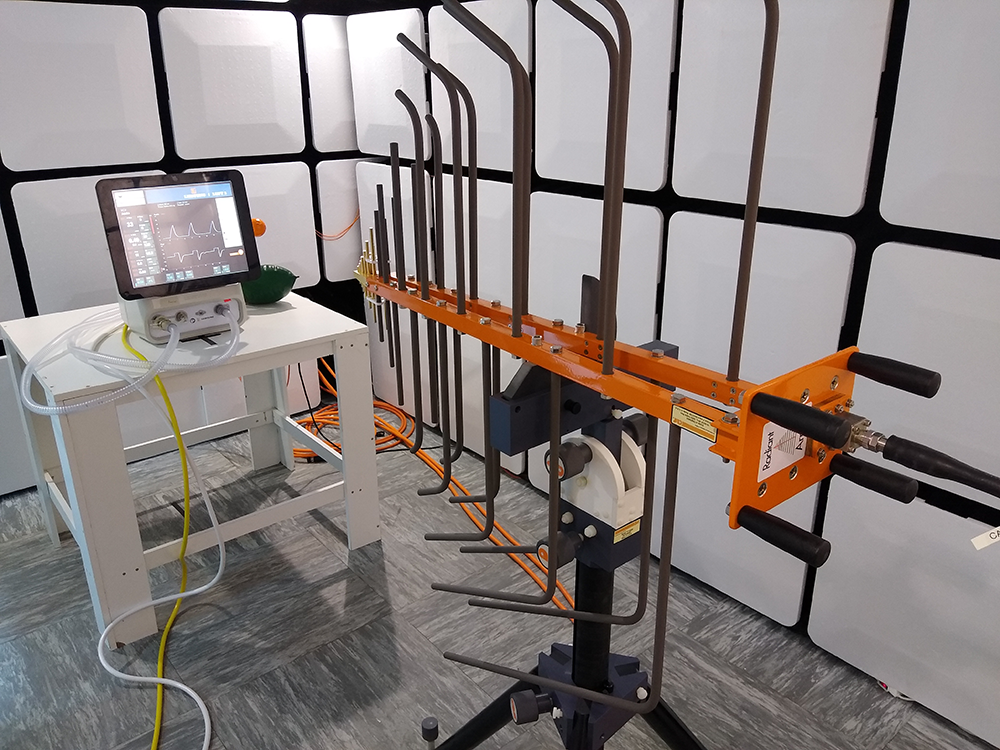
  

Avalon Test Equipment carries a wide variety of EMC test equipment ranging from ESD guns and RF amplifiers to immunity testers. Browse our inventory by category to fulfill specific testing requirements and Test With Confidence®.

Read More

Read Less

ETS Lindgren 3183B Broadband Mini-Bicon Antenna

ETS-Lindgren's Model 3183B is an end fed Mini-Bicon Antenna designed for CISPR 16-1-4 and ANSI C63.25 chamber validation testing above 1 GHz. The frequency range for the Model 3183B is 1 GHz to 18 GHz.

Rohde & Schwarz HZ540 Near Field Probe Set

Rohde & Schwarz HZ540 Near Field Probe Set with Electrical, Magnetic, and High Impedance Probes

Rohde & Schwarz HZ-15.02 Probe Set

Rohde & Schwarz HZ-15.02 Probe Set for E and H Near-Field Emissions 30 MHz to 3 GHz

Rohde & Schwarz HZ-17.02 Probe Set

Rohde & Schwarz HZ-17.02 Probe Set for H Near-Field Emissions 30 MHz to 3 GHz

Rohde & Schwarz SMB100A RF and Microwave Signal Generator

The compact, versatile R&S®SMB100A microwave signal generator with a frequency range up to 40 GHz provides outstanding spectral purity and high output power.

Rohde & Schwarz ESRP3 EMI Test Receiver

EMI Test Receiver for CISPR 16-1-1

EMC Partner MIL3-REC

Plug-in for MIL3 Generator for testing MIL-STD-461 CS115

EMC Partner MIL3-10K10M

Plug-in to MIL3 for CS116 Testing 10, 100 kHz and 1 to 10 MHz

EMC Partner MIL3-30M100M

Plug-in to MIL3 for CS16 testing 30 and 100 MHz

EMC Partner AVI-LV3 em

A flexible solution that includes MIL-STD-461: CS117, Level 1 (internal equipment), RTCA DO-160: SECTION 22, Level 3, and EUROCAE ED-14: SECTION 22, Level 3.

EMC Partner CN-BT7 Injection Probe

Large diameter injection probe for DO-160 Section 22 and MIL-STD-461g CS117 cable bundle tests with AVI3000

Newtons4th PPA5531 Three-Phase Precision Power Analyzer

Three-phase power analyzer with harmonics & flicker

Rohde & Schwarz ESPC EMI Test Receiver

150KHz-1GHz EMI Test Receiver

Avalon Microwave & Millimeter Wave Solution Union Cables

Avalon Test Equipment microwave and millimeter wave cables for 5G communication, EMC, and antenna testing. Comes in 18 inch and 30 inch sizes

Maury RF Power Amplifier 0.6-6 GHz, 20W

This device spans a 0.6-6 GHz frequency range, with a 20 W Psat (both typical and minimum). It accepts an input power up to 0 dBm and delivers a small signal gain of at least 46 dB. The gain flatness is typically ±4 dB, with a 20 dB gain adjustment option. The input VSWR is a maximum of 2:1, while the output VSWR under Psat is 3:1. Harmonics are managed with a 2nd harmonic power at Psat of -15 dBc and a spur at Psat of -65 dBc. Intermodulation performance is noted at -39 dBc (13 dB back off) and -27 dBc (3 dB back off). The unit is unconditionally stable, classified under ECCN EAR99.For the mechanical specs, it has an enclosure type B, weighs 26 lbs, and uses SMA Female connectors. Environmentally, it operates between 0ºC to 50ºC and stores from -25ºC to 65ºC.

Maury RF Power Amplifier 0.6-6 GHz, 60W

This device features a frequency range of 0.6-6 GHz and delivers a powerful Psat of 60 W, both typical and minimum. It can handle an input power of up to 0 dBm and offers a small signal gain of at least 50 dB. The gain flatness is typically ±4 dB, with a 20 dB gain adjustment capability. The input VSWR is a maximum of 2:1, and the output VSWR under Psat is 3:1. Harmonic and spurious outputs are well-controlled, with a 2nd harmonic power at Psat of -15 dBc and a spur at Psat of -65 dBc. Intermodulation distortion is also minimized, with IM3 values of -39 dBc at 13 dB back off and -25 dBc at 3 dB back off, with a 10 MHz tone spacing. The device is unconditionally stable, classified under ECCN EAR99.In terms of mechanical specs, it has an enclosure type A and weighs 42.3 lbs, with Type N Female connectors for RF input/output. The operating temperature range is 0ºC to 50ºC, and it can be stored between -25ºC to 65ºC, ensuring durability across various environments.

Maury RF Power Amplifier 0.6-6 GHz, 100W

This robust device operates within a 0.6-6 GHz frequency range and boasts a Psat of 100 W, both typical and minimum. It can accommodate an input power of up to 0 dBm and provides a minimum small signal gain of 50 dB. The gain flatness is typically ±4 dB, complemented by a 20 dB gain adjustment feature. The input VSWR is limited to a maximum of 2:1, while the output VSWR under Psat is 3:1, with infinite protection available with Option MPA-COUP. Harmonic and spurious outputs are well-managed, with a 2nd harmonic power at Psat of -15 dBc and a spur at Psat of -65 dBc. Intermodulation distortion is also minimized, with IM3 values of -39 dBc at 13 dB back off and -25 dBc at 3 dB back off, with a 10 MHz tone spacing. The device is unconditionally stable and falls under ECCN 3A001.b4.a4. The mechanical specs include an enclosure type C and a weight of 84 lbs, with Type N Female connectors for RF input/output. The operating temperature range is 0ºC to 50ºC, and it can be stored between -25ºC to 65ºC, accommodating various environmental conditions.

Maury RF Power Amplifier 0.6-6 GHz, 200W

This advanced device operates within a 0.6-6 GHz frequency range and ensures a strong Psat of 200 W at minimum. It’s capable of receiving an input power up to 0 dBm and provides a small signal gain of no less than 50 dB. The gain flatness stands at a typical ±4 dB, with the ability to adjust the gain by up to 20 dB. It features an input VSWR of up to 2:1 and an output VSWR of 3:1 under Psat conditions. Harmonic and spurious emissions are kept in check, with a second harmonic at Psat of -15 dBc and spurious at Psat of -65 dBc. Intermodulation distortion is minimized, with IM3 levels of -39 dBc at a 13 dB back off and -25 dBc at a 3 dB back off, using a 10 MHz tone spacing. The device is unconditionally stable and falls under the ECCN 3A001.b4.a4 classification. On the mechanical front, it has a Type C enclosure and a weight of 84 lbs, with Type N Female connectors for RF input and output. It operates effectively within a temperature range of 0ºC to 50ºC and can be stored from -25ºC to 65ºC, ensuring robust performance in various conditions.

Maury RF Power Amplifier 0.6-6 GHz, 500W

This device is designed to operate within a 0.6-6 GHz frequency range and delivers a minimum Psat of 500 W. It can accommodate an input power of up to 0 dBm and ensures a small signal gain of at least 50 dB. The gain flatness is typically ±4 dB, with a 20 dB gain adjustment option. The input VSWR is a maximum of 2:1, and the output VSWR under Psat is 3:1. Harmonic and spurious outputs are well-managed, with a 2nd harmonic power at Psat of -15 dBc and a spur at Psat of -65 dBc. The device maintains unconditionally stable performance and is classified under ECCN 3A001.b4.a4. Mechanically, it features an enclosure type E and weighs 500 lbs, with Type N Female connectors for RF input and a 7/16 connector for RF output. Environmentally, it operates efficiently between 0ºC to 50ºC and can be stored from -25ºC to 65ºC. The device requires a 3 phase 208 V voltage and a 27 A current to function optimally. It also offers infinite protection with the optional MPA-COUP feature.

Maury RF Power Amplifier 2-6 GHz, 100W

This device is tailored for a 2-6 GHz frequency range, with a 100 W Psat that’s both typical and minimum. It accepts an input power up to 0 dBm and ensures a small signal gain of at least 50 dB. The gain flatness is typically ±2.5 dB, and it offers a 20 dB gain adjustment. The input VSWR is capped at 2:1, and the output VSWR under Psat is 3:1. Harmonic and spurious emissions are controlled, with a second harmonic at Psat of -15 dBc and spurious at Psat of -65 dBc. Intermodulation distortion is minimized, with IM3 levels of -44 dBc at a 13 dB back off and -29 dBc at a 3 dB back off, with a 10 MHz tone spacing. The device is unconditionally stable and classified under ECCN 3A001.b4.a4. In terms of mechanical design, it features an enclosure type A and weighs 48 lbs, with Type N Female connectors for RF input and output. It operates within a temperature range of 0ºC to 50ºC and can be stored from -25ºC to 65ºC, ensuring reliable performance across various environmental conditions.

Maury RF Power Amplifier 2-6 GHz, 200W

This device operates within a 2-6 GHz frequency range and provides a 200 W Psat, both typical and minimum. It can handle an input power of up to 0 dBm and offers a small signal gain of at least 50 dB. The gain flatness is typically ±2.5 dB, with a 20 dB gain adjustment capability. The input VSWR is a maximum of 2:1, and the output VSWR under Psat is 3:1. Harmonic and spurious outputs are well-controlled, with a 2nd harmonic power at Psat of -15 dBc and a spur at Psat of -65 dBc. The device is unconditionally stable and falls under ECCN 3A001.b4.a4. For mechanical specifications, it features an enclosure type C and weighs 64 lbs, with Type N Female connectors for RF input and output. The operating temperature range is 0ºC to 50ºC, and it can be stored between -25ºC to 65ºC, ensuring durability across various environments.